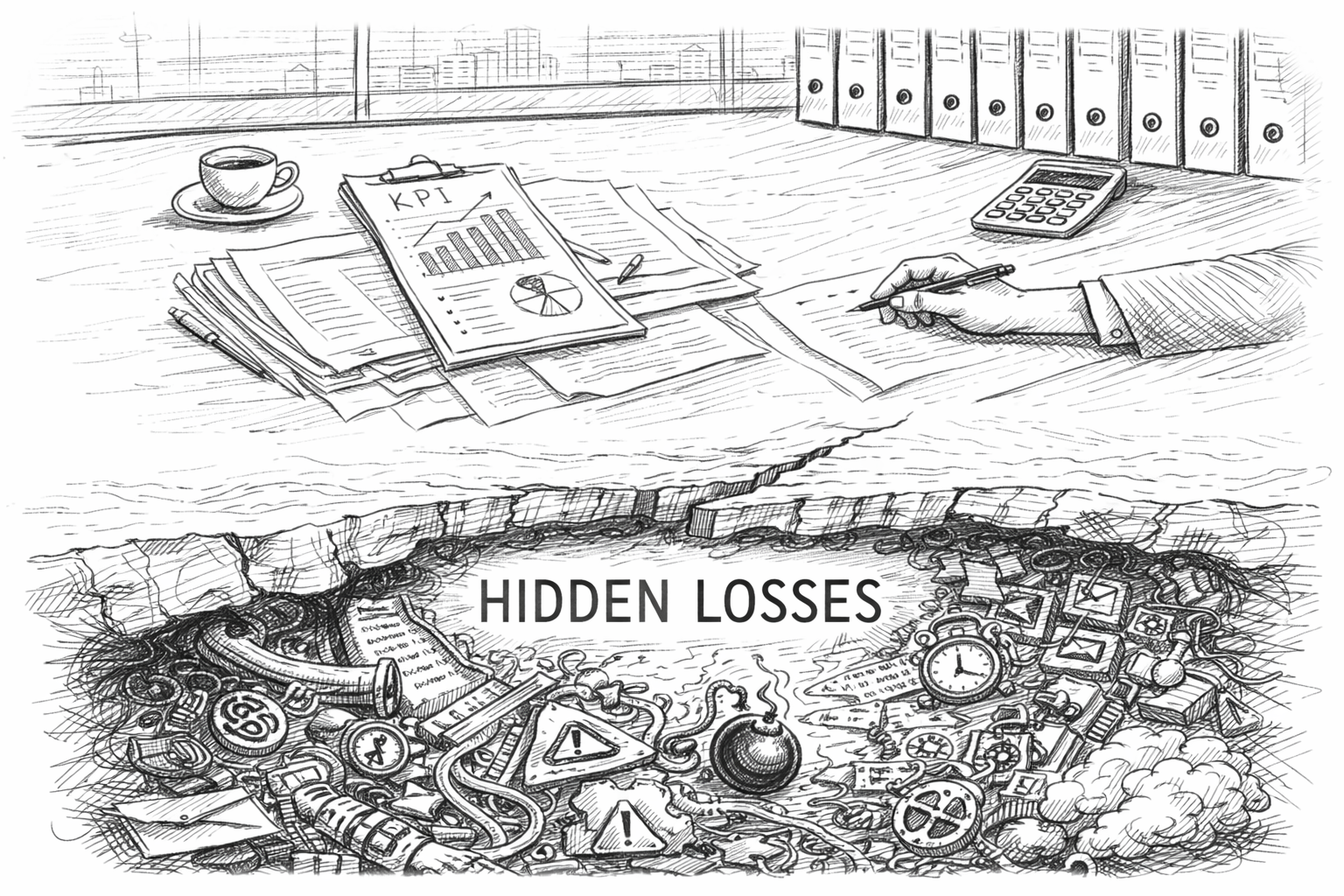
At a certain stage of a manager’s maturity, a special feeling may begin to arise within them.
It rarely appears in novice managers and almost never in systems clearly in crisis. Most often, it arises precisely where the business is already established, processes are documented, the team is working, and results overall meet expectations.
Formally, everything looks correct:
- processes are documented and executed;
- KPI are being met or are close to target values;
- people are busy working, decisions are made, reporting matches up;
- there are no obvious crises, accidents, or failures.
And yet there is a subtle, hard-to-formalize feeling that the system is working not perfectly, as if with some internal resistance, with a barely noticeable “grit in the mechanism.” This feeling is rarely expressed in words like “we have a problem.” More often, it is formulated differently:
- “We spend too much effort on simple things.”
- “Each process separately is logical, but altogether it feels heavy.”
- “There are many small delays that are hard to catch and record.”
- “We are constantly just barely running behind, even though formally we should keep up.”
This state is the borderline zone between the norm and the beginning of managerial entropy, precisely the zone in which hidden losses.
Why this feeling matters
Management practice shows that when a manager begins to feel this kind of “roughness,” the system is already sending a signal, but has not yet not through numbers, but through dynamics.
It’s important to emphasize: this is not intuition in a mystical or irrational sense. It is a cognitive trace of multiple micro-failures, which have not yet formed into a single measurable problem, but already:
- increase internal friction;
- require more energy to achieve the same result;
- reduce the subjective sense of control and manageability.
In the logic of LAM, this state is considered an early phase of hidden loss manifestation — a phase when the system is already paying a price, but does not yet realize for what exactly.
At the same time, it is important to always remember that hidden losses by their nature are not an event. They are a process. They exist as energy leaks scattered throughout the system: somewhere in unnecessary clicks, somewhere in repeated ‘one-time’ rush jobs, somewhere in incorrect KPI parameters, somewhere in unspoken rules of distrust that stifle initiative and innovation.
Therefore, the awareness of hidden losses is like the situation when a faint extraneous sound appears in a car. It is not yet a breakdown. But it is a signal that the system is operating with resistance. The question is, what do you do after you hear this sound.
If the answer is, ‘Well yes, it seems there is a noise… but the car is moving,’ then this noise will become louder over time. Because the nature of hidden losses is this: if you don’t address them, they don’t disappear. They become entrenched. They become normalized. They start to reproduce themselves as a habitual dynamic.
Awareness without action is like noticing noise in the engine but not opening the hood.
Business will never fix hidden losses on its own, because hidden losses exist precisely because the system has learned to function in a way that ignores them. This is the key paradox: if a loss has become hidden, it means it’s embedded in the system’s self-justification mechanism.
It is disguised as one of three things:
- “That’s how business works”
- “It’s an industry-specific issue”
- “It’s the human factor”
And each of these explanations contains a refusal to manage.
Losses become hidden not because they are impossible to notice. They become hidden because noticing them is inconvenient.
It’s inconvenient to admit that a process can be simplified.
It’s inconvenient to see that planning is done “from scratch,” ignoring past experience.
It’s inconvenient to admit that the KPIs are set up in a way that creates a loss–loss scenario and builds up counterforce within people.
It’s inconvenient to look at the trust rules and see that innovation is suppressed not by the external market, but by the internal attitude toward your own team.
Business, like any complex system, strives for stability. And if losses are embedded in its stability, the system will protect them. Not intentionally, not consciously, not “with malicious intent.” Simply because to the system, “familiar” means “safe.”
That’s why becoming aware of hidden losses does not trigger automatic correction. On the contrary: at the moment of awareness, discomfort often intensifies. The system seems to start resisting attention paid to it.
A manager may experience it like this:
— “Yes, I see that something here is excessive. But it’s been working for years.”
— “Yes, deadlines keep shifting, but it’s the same for everyone.”
— “Yes, the KPI is odd, but it’s approved, and changing it is difficult.”
— “Yes, the team is demotivated, but if you don’t push them, they won’t do anything anyway, plus, we need to save costs.”
All of this is the system’s way of protecting itself from interference.
Manifestation of hidden loss impact at the levels of the LAM Management Pyramid
Action level (what people do every day)
At the action level, hidden losses are felt as:
- extra operations that ‘seem necessary’, but no one can clearly explain why;
constant micro-rechecks; - duplication of the same steps by different roles;
- waiting for approvals that are formally quick but actually disrupt the rhythm.
At this level, people rarely say “we have a bad process.”
Much more often you hear phrases like:
- “That’s the way it’s done.”
- “It’s easier to do it myself.”
- “Better safe than sorry.”
The manager sees that people are busy, occupied, engaged, but the results of this busyness are below expectations.
A typical example from practice:
In the warehouse, there is an ongoing effort to increase productivity without sacrificing quality. An advanced WMS was used, where the picking process was set up as follows: the employee scanned the picking bin and then scanned the barcode of the product being picked. This logic was adopted during previous implementations and operated unchanged for almost ten years.
Productivity targets were met, and the error rate was below the level agreed with the client. Formally, everything looked correct.
However, some simple but fundamental questions arose:
- How long does one click take?
- What is the chance that the wrong product ends up in the correct bin?
- What happens if one of the clicks is eliminated?
The answers turned out as follows:
- one click takes about one second;
- for years, there have been no cases of incorrect items in the bins.
Next comes simple arithmetic:
The company has 4,000 pickers working in two shifts. On average, each of them makes 850 picks from bins per shift. That’s 1,700,000 clicks per day, or 1,700,000 seconds of human time. This equals 14,166 man-hours per month, or nearly 80 employees working 10-hour shifts (2% of the staff). Practice confirmed the calculations: by eliminating one of the two clicks, productivity increased by 2–4% in different areas of the distribution center.
This is a classic example of hidden losses at the action level: this loss was ‘invisible’ because the system operated ‘normally.’
Event level (things that happen regularly but are perceived as random)
At the event level, hidden losses manifest themselves in an especially insidious way. Here they already repeat, but are still not recognized as a system. As a rule, at this level the following appear:
- repeated ‘one-off’ situations;
- constant small emergencies;
- minor deadline failures, each time due to an ‘objective reason’;
- decisions that have to be made at the last minute.
Each such event individually does not seem critical. And most importantly — it always has an explanation, a justification, or an external factor. However, it is the frequency and recurrence that create an atmosphere of constant tension and reactive management.
For example — a constant shift in project deadlines by the contractor.
Deadlines for project completion are regularly missed at the company. Formally, each case has its own explanation: the contractor let us down, requirements changed, approvals were delayed, unforeseen circumstances arose. However, something fundamentally different is important: new plans are developed each time as if from scratch, without considering previous experience, without analyzing actual deviations, and without adjusting the original assumptions.
As a result:
- deadlines are systematically not met;
- delays are no longer perceived as deviations;
- they become the norm.
At a certain point, a qualitative shift in perception occurs: no one ‘freaks out’ about deadlines anymore, and more importantly, no one truly believes in them. This is a critical point. Because from here, the chain of consequences goes beyond the bounds of the project function.
If such objects are, for example, stores, then timeline shifts directly start to affect sales plans, marketing campaigns, personnel planning, financial flows. However, when analyzing the underperformance of sales plans, questions for some reason are not addressed to those who failed to deliver the objects on time, but to the commercial unit, the market, the sales team, or the ‘state of the economy.’
Thus, hidden loss at the event level manifests itself as follows:
- the systemic cause is disguised as a chain of isolated incidents;
- responsibility becomes diluted;
- the consequences are ‘shifted’ to other functions;
- management attention moves from the source to the symptoms.
This is a classic area of hidden loss, where the business is already paying the price — in time, trust, money, and energy — but continues to view what is happening as operational reality rather than a managerial problem.
Parameter level (standards, KPIs, thresholds, tolerances)
Here, ‘roughness’ is felt especially acutely:
- KPIs are formally achieved, but there is no sense of actual result;
- growth in one indicator worsens others;
- people start optimizing metrics, not real results;
- the system requires constant manual adjustment of parameters.
A dangerous discrepancy arises: the numbers say everything is fine, but the managerial sense is that ‘something isn’t right.’
A vivid example — an improperly structured KPI system at the top management level:
A service enterprise (for example, a warehouse operator for a retail chain). The director is given a key KPI: “operating costs per unit shipped to the chain.” Formally, this makes sense: the company provides logistics services for the chain, and the main task is to reduce the added cost of products.
However, the company also has a profitable 3PL division not related to shipments to the chain. Naturally, developing this division, although it increases the company’s overall profit, also increases total costs, which worsens the director’s personal KPI that determines their bonus.
This creates a “loss–loss” scenario: either the director shuts down a profitable division for personal incentive, or continues to develop it, forfeiting income and accumulating a sense of injustice — a counterforce, which over time reduces their effectiveness at a psychosomatic level.
The level of rules (the principles by which the system operates automatically)
This is the deepest and most dangerous zone.
Here, hidden losses manifest as:
- unspoken rules like “this is safer”;
- decisions made out of habit;
- fear of disrupting the process even when it is clearly inefficient;
- formal courage without real accountability.
The manager senses:
- that the system resists change;
- that improvements require disproportionate effort;
- that people are “doing the right thing,” but the result remains mediocre.
This means that the losses are fixed in the rules and are reproduced automatically.
A characteristic example is a situation where the opinions of the people actually responsible for the process are devalued, while external and often superficial judgments are trusted more.
The company’s management initiated a project to purchase non-standard, complex production equipment. The team conducted a full-scale tender, thoroughly researched the market, and selected the optimal contractor. But at the stage of finalizing the decision, the management stated: “too expensive”, “you didn’t research the market well”, etc., etc.
As a result, the process was stopped, another three months of extra work, negotiations, and explanations followed—and ultimately, the original decision was confirmed, with a complaint from management that the team took too long to resolve the project.
Questions arise:
- is there motivation for innovation in such a system?
- how competitive is a company with such rules?
That is why hidden losses at the rule level are the most destructive, since they affect not only efficiency, but also the very meaning of the business’s existence.
The principle of force and counterforce (a bit of psychology in our business article)
In the Gestalt approach, there is a fundamental principle that very clearly reflects the presence of hidden losses: every force always has a counterforce (or, if you prefer physics—Newton’s classic third law).
In management, this means that any progress, any change, any decision always generates system resistance. Counterforce always exists—even if we don’t notice it.
Why is the counterforce invisible? In business, counterforce rarely appears as open conflict.
More often, it manifests through:
- slowdowns;
- complications;
- formal agreement without real implementation;
- an increase in exceptions;
- distributed micro-resistance.
As long as the counterforce is small, the system compensates for it imperceptibly. But if it isn’t recognized, it accumulates, intensifies, and ultimately either balances the force, or pushes the process back, causing a rollback or crisis.
Thus, hidden losses are the footprint of unacknowledged counterforce. We see movement,
but we don’t see what resists it, and we pay for this with energy, time, tension, and money. Until the counterforce is named and recognized, it isn’t managed,
but it is already subtly influencing the outcome.
Management takeaway and steps to action
The feeling of “roughness” is not a weakness of the manager or anxious intuition. It is an early signal from the system, which appears before losses become measurable.
Understanding Hidden losses starts right here:
- with paying attention to these sensations;
- with refusing to devalue them;
- with shifting them from background noise to an object of managerial analysis.
However, awareness alone is not enough. As soon as hidden losses become visible, the management faces the next question: exactly what are we losing, where, why, and who is responsible for it?
This is where the following LAM methodologies become necessary:
- LAM loss register — to record losses as a management reality;
- LAM loss map — to see their systemic connections and root causes;
- LAM exponential rule — to eliminate them organically, without destroying the system;
- LAM early warning indicators — to notice them next time before they become a problem.
Hidden losses — this is the entry point. This is the start of the path to conscious loss management.
In the next article, we will talk in detail about such a methodology as loss register (LAM loss register) without which hidden losses will remain at the level of perceptions and will not become an object of management.