
The goal of any business is to generate profit. This is only possible if two main business principles are observed: efficiency and rationality. Efficiency is the confident achievement of set goals. Rationality is the use of a minimal amount of resources. In other words, if we combine the descriptions of both principles, a successful and profitable business is a system that ensures the confident achievement of planned results while using the least possible resources.
A great deal of attention is always paid to achieving results. There are many methodologies and models. All of management is constantly engaged in setting tasks and organizing their completion, yet these efforts, even if they lead to the desired results, do not always result in the business receiving the expected profit. Why does this happen?
Businesses are started by entrepreneurs, people who take on the risk of loss in case of failure. Their ideas and energy are what set the business in motion. In fact, they direct and organize resources—intellectual, financial, emotional—toward their goal.
They disrupt the balance. Before them, there was equilibrium in this area; from the moment they began to build their business, that balance was broken. If on one side there is the energy of order, what is on the other side? It is logical to assume that it is the energy of disorder—dissipative energy, the energy of entropy.
Entropy, as a measure of chaos, in other words, characterizes the deviation of a real process from the ideal.
Thus, at the starting point of a business, there is equilibrium; then, the founder’s energy disrupts the balance in favor of implementing the business idea, and the energy of order begins to prevail over the energy of entropy, the energy of disorder. So, what happens next?
If the business idea is strong and the actions taken to implement it are correct, the business grows, or in other words, becomes effective. It achieves the goals set before it. So where do crises and failures come from? Why do mishaps happen? Why doesn’t the result always match the plan? What causes things to deviate from the set path of development? There are several reasons. Sometimes, the founder loses interest and stops holding on to the original meaning, sometimes he or she cannot adapt to changes in the environment and tries to repeat past successes by following an already trodden path, sometimes the strategy becomes outdated, and so on.
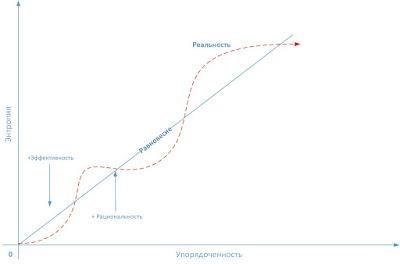
The point is that the more effort an entrepreneur puts into creating order, the more resistance from entropy must be overcome. In other words, the formula for success looks like this: to achieve ever greater profits, the entrepreneur must make ever greater efforts, overcoming ever greater resistance. Nature loves equilibrium! And all our efforts are a disruption of the natural balance.
When a business first encounters the situation where, despite achieving sales or volume targets, profit does not meet expectations, it’s time to pay attention to rationality. Rational use of resources!
What does this mean? It means that every decision involving the use of any resources must be evaluated from the perspective of their most rational use. Rational use and saving are not synonyms. Saving implies giving something up, while a rational approach means making the best use of what you have. So, what prevents us from always applying the principle of rationality?
How can you distinguish rational use from irrational use?
If I achieved a result, for example, sold products worth 1 million USD and my expenses, both direct and indirect, amounted to 0.95 million USD, then, simply put, my profit would be 0.05 million USD or 5% of net sales (ROS = 5%, Return On Sales). By using a rational approach, we could, for example, see that:
- there was an opportunity to offer a 1% smaller discount than was actually given. Or to receive an additional 0.01 million USD;
- deliver the products in two instead of four shipments, reducing delivery costs by 0.005 million USD;
- move the delivery 2 days earlier and avoid missing a delivery to another client, for which the company was fined 0.001 million USD;
- sign an annual contract instead of a one-time agreement, and get optimization through economies of scale of 1.5% on the full annual volume, or 0.015 million USD on the already sold batch;
- use other materials in packaging, since the client uses the product unpackaged, and reduce the cost price by 0.5% or 0.005 million USD;
- when agreeing on the contract, three employees not related to the deal participated in the procedure, which resulted in a delay in signing;
- failure to maintain the required temperature during delivery could have led to a complete return of the entire batch on formal grounds and losses amounting to the full value increased by the cost of return shipping and a 10% penalty of the delivery amount;
- overtime work at production to create product stock to replace the shipped batch cost the company an additional 0.01 million USD;
- and so on.
As you can see, taking the above factors into account could increase profits by at least 2 times!
Establishing deep cause-and-effect relationships with a monetary assessment of the impact of various factors helps to indicate so-called hidden losses, and to develop measures to eliminate them in the future. Hidden losses are dangerous because, until we identify and assess them, they seem to us like quite ordinary and unavoidable operating expenses that cannot be avoided.
According to statistics, hidden losses can be comparable to net profit and amount to between 1% and 8% of turnover. It all depends on the sector of the economy and the level of company development. The volume of hidden losses in the US retail trade segment alone, for example, is estimated at no less than $35 billion USD per year. In the given example, if all interconnected hidden losses suffered by the enterprise as a result of this transaction are taken into account, then its profitability may be called into question. Most people do not pay attention to hidden losses, although many actions to prevent them can be taken in advance. And what is not spent (lost), is earned.
Increasing the efficiency of resource utilization based on the Loss Prevention (LP) model can greatly improve your net profit and create additional competitive advantages over your competitors.
Implementing a constant business function of “Loss Prevention” within your company, alongside functions such as “Finance,” “Logistics,” “Marketing,” and others, will help increase your company’s ability to withstand the destructive effects of entropy and enhance the order you create in the direction of your goals.
Filyanin S.N.
03.2019