
“Everything flows, everything changes.
But there are laws according to which this happens”
(Heraclitus)
Imagine a typical situation. A company has been operating for several years under a well-established system: clear KPIs, regulations, monthly planning, proven management tools. Everything looks stable. And then the market changes, customers start behaving differently, the team stops “feeling” priorities, and the usual management levers give less and less results. Fires break out in different places. The manager tightens control, rewrites the rules, changes KPIs… and only gets new fires.
Sounds familiar?
One manufacturing and trading holding implemented “best practices” and a KPI system for three years in a row. The indicators grew well on paper. And then it turned out: the real margin was decreasing, because the rules stimulated the production of volume, not value for the client. After that, the company struggled with the consequences of its own regulations for two years.
In another company – a strong IT team – everything was “Agile”. Sprints, retro, speed metrics. So far, the market has not changed. Then it turned out that the rules that previously gave speed now kill the ability to quickly change direction. The team ran faster and faster… but not there.
In our first book – “LAM thinking: from losses to profits” – we looked for hidden reserves through process optimization and elimination of operational losses. The practice of working with dozens of companies has shown an important limit: any system built only on rules and regulations remains successful exactly as long as these rules and regulations correspond to the laws of reality.
It’s time to take the next step — to move from consequences to causes.
Why do reliable rules stop working?
In the LAM methodology, we use the Management Pyramid. Everything that happens in an organization is divided into four levels:
- Actions (foundation);
- Parameters;
- Events;
- Rules (top).
Most popular approaches (Agile, Lean, BSC, TOC) work mainly with actions, events and parameters. Sometimes they change the rules. But the rules themselves are not the original source. They are man-made algorithms. For them to work, they must correspond to the fundamental laws of the real world.
When the external environment changes, old rules lose their connection with these laws and become a source of hidden losses. The company begins to spend its energy not so much on development, but on fighting the consequences of its outdated rules.
What are the fundamental laws of business?
Fundamental laws are not advice, recommendations, or management fashion.
A law is a description of the structure of reality: what happens to the system is inevitable, regardless of our faith, competence, or industry.
Like the law of gravity, the fundamental laws of business always work. If an organization consciously adheres to them, it retains its stability and ability for breakthrough development. If it violates them, it faces degradation, loss of subjectivity and losses that could have been avoided.
What the system is based on
In our methodology, business is considered as a complex, dynamic, self-organizing system. Therefore, the system of laws is based on a proven ontological foundation – the general laws of dialectics and key pairs of categories.
Three laws that are especially important for management:
- Unity and struggle of opposites. Business always develops through the management of internal contradictions: growth ↔ stability, speed ↔ control, innovation ↔ reliability.
- The transition from quantity to quality. Small errors and micro-losses accumulate imperceptibly until they lead to a qualitative breakdown of the system.
- Denial of denial. Development goes in a spiral: the new model retains the working core of the previous one and raises it to a new level.
Understanding these connections allows a manager to rise above the operational bustle and see the real reasons for what is happening, and not just their visible manifestations.
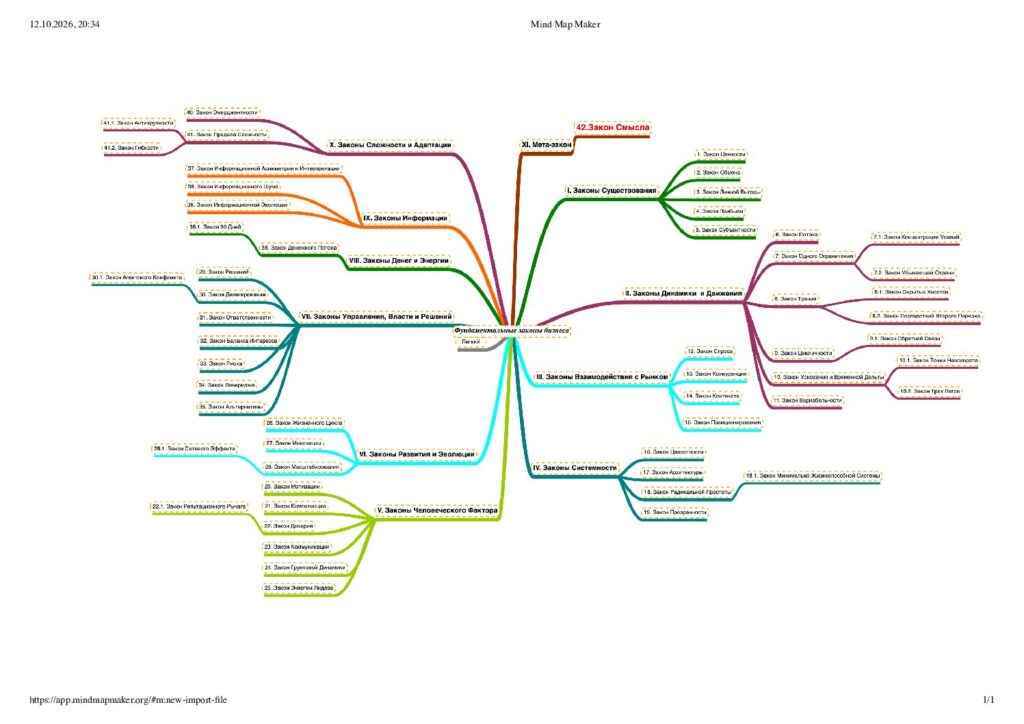
System Architecture: 42 Laws
The entire system consists of 11 thematic blocks and 42 universal laws.
The number 42 turned out to be no coincidence. In The Hitchhiker’s Guide to the Galaxy, a supercomputer spent millions of years calculating the Answer to the Ultimate Question of Life, the Universe, and Everything — and came up with 42. The paradox is that the answer itself is meaningless until you learn to ask the right questions to your system.
key areas:
- Laws of Existence and Dynamics;
- Laws of Interaction with the Market and Systematicity;
- Laws of Information, Complexity, Development and Evolution;
- Laws of Management, Human Factor and Cash Flows;
- Meta-Law of Meaning (Law No. 42).
Below is a diagram of the full map of 11 blocks and 42 laws. Keep it as a navigator!
Why is this necessary right now
1. Maintaining subjectivity. There are two fundamentally different states of a manager.
In the first, you are a subject. You see the system, understand the laws by which it lives, and make decisions consciously. Even in chaos, you have a point of support.
In the second, you are an object. The company, the market, fires, and other people’s rules control you. You run, put out fires, change KPIs, hold meetings — and with each passing month, you feel less and less that the wheel is really in your hands. This is one of the most difficult feelings for an owner and top manager: the business seems to be yours, but you are no longer the one managing it.
Knowledge of fundamental laws returns subjectivity. Not as a good idea, but as a working tool: you begin to see the causes again, and not just the consequences.
2. Prevention of irreversible damage. The main goal of applying LAM is not just to maximize momentary success, but to systematically avoid losses with a fatal price. “The losses you avoided become your profit!”
3. Punctuality and resource economy. To return the system to balance, you do not need to solve 42 problems at once. It is enough to find 1 key constraint and 2 supporting laws.
This is an introduction. Next, we will analyze the laws one by one – with examples, manifestations in real companies and practical questions that you can ask your system today.
If there are already situations in your practice where the rules suddenly stopped working – write. Let’s analyze together which law was violated here.
Ontological passport (briefly)
Case: loss of effectiveness of proven tools and rules in changed conditions.
Main meta-thesis: Rules and tools are the consequence. Fundamental laws are the cause.
Key law of dialectics: transition of quantitative discrepancies between rules and reality into a qualitative management crisis.
Pair of categories: Cause – Effect / Essence – Phenomenon.
October, 2026
Filyanin S.