
This article discusses what the standard approach to employee development and motivation looks like in the vast majority of companies. It addresses what is actually hidden behind fancy slogans, and why we consider this predominantly as negative manipulation rather than a positive influence on staff. In the corporate world, there are many examples of companies that have abandoned covert or overt manipulation, started to implement a more proper HR policy, and, as a result, became great. We all know them: Google, Apple, Microsoft… Few would argue that building not just an ordinary, but an outstanding and successful company begins with revisiting and properly understanding your human capital management strategy.
HR Tasks
Typically, the HR department of any company faces three main tasks.
- Ensure proper and timely personnel administration in accordance with all formal legal requirements,
- Organize the search and hiring of necessary personnel,
- Develop and maintain an effective model for employee motivation and development.
Let’s examine the solution to the second and third problems. If we look at the description of personnel policy in most companies, we will see in it many familiar phrases, such as “development of human capital,” “increasing staff competency levels,” “corporate culture,” “instilling the idea in employees that the company is a big family,” “creating a career ladder for each employee,” “forming a talent pool,” “corporate university,” “grades,” “levels,” and so on. We will find there promises of constant concern for the development of each employee, fair compensation for completed work, encouragement of individual and collective initiative, and a spirit of competition.
But why do these words often provoke a wry smile or boredom among most company employees?
How is it that many employees go years without receiving the promotion they desire? How is it that people keep working while accepting salaries that do not satisfy them? How is it that it is not the most prepared and qualified employee who gets promoted, but rather the one who can be counted on not to threaten the position of their superior? Why do employees not always speak positively about their managers when talking to each other? Why do employees in many companies refer to their company rules as something like “the madhouse ‘Sunshine’?”
Could it be that in most companies, one set of HR objectives is declared, but a completely different set is pursued? And is this the essence of manipulation?
So what objectives does HR actually pursue?
Well, for example, to increase staff productivity without additional costs, or to fire employees who show too much initiative and, so to speak, generate waves of innovation that make management (business owners) uncomfortable. After all, many managers and executives only like innovation in words, but in practice prefer to stick to well-known and proven algorithms. And when HR receives an order from the boss to “fire employee N,” HR simply carries out this order without considering how this action aligns with the company’s declared HR policies.
As a professional, HR understands that training and upskilling employees is a very important task. But at the same time, HR is not interested in having their work evaluated by management. For instance, after training or workshops, the HR department usually does not track any improvement in the effectiveness of the employees who attended.
At the same time, HR justifies themselves by saying that real skills development requires completely different training costs, and the budget allocated for these purposes can only provide a rather modest increase in employee efficiency. But very rarely does HR take a professional stand when speaking with the business owner, as they want to keep their job.
When recruiting staff, HR usually operates on the premise that the average salary for a vacant position on the labor market is Y. Therefore, when a candidate comes to an interview asking for a salary of 2Y and guarantees to increase the company’s profit by 1.2 times through the use of modern professional knowledge and approaches, HR usually decides that the company does not need such an employee.
As a result, the staff is filled with unambitious people with modest needs and average abilities. Does the company benefit from this? Does it become more competitive? Will it be able to take market share from its competitors? Of course not! But HR reports to the business owner or supervising CEO about a 2% payroll savings and considers it an achievement. I think you understand the difference between saving 2% on payroll and increasing the company’s profit by 20%.
When given the task by the business owner or a supervising top manager to develop a new staff motivation system, HR will primarily be concerned not with making sure the new motivation model truly motivates employees to work at their full potential, but with finding ways to confuse or deceive the staff and, in effect, reduce the company’s expenses on motivational programs. For this, highly sophisticated motivational schemes are often invented.
So as not to take up too much of your time, we won’t provide more examples. We think you yourself have seen many times how HR is, in fact, just doing their job while pretending to be guided by current corporate HR policies, caring about increasing human capital, and so on.
Now let’s formulate the correct foundation of HR activities.
An employee, regardless of their position—be it CEO or courier—remains a human being above all else. Every person strives primarily to satisfy their personal needs for security, social recognition, and self-fulfillment. These needs can only be met by fulfilling three important working conditions.
1. The employee should be doing work that they like and love.
2. The employee should be in conditions that satisfy them. Comfortable relationships within the team, a convenient workplace equipped with everything necessary, and fair requirements and assessment from the management.
3. The total compensation the employee receives for their work should be perceived as fair and sufficient.
In other words, the satisfaction triangle must be fulfilled. Satisfied with the work, satisfied with the conditions, satisfied with the compensation.
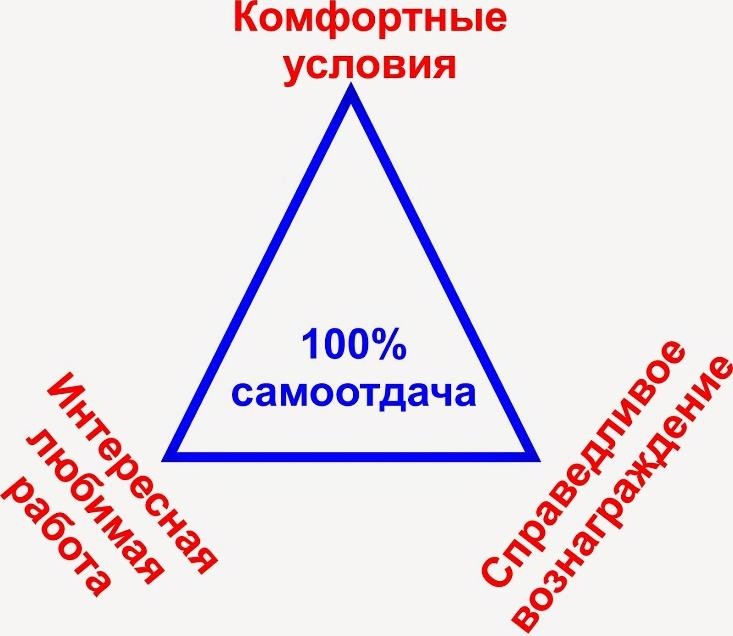
Figure 1
Only when these three conditions are met, the employer can expect one hundred percent commitment from the employee.
Imagine a company where these conditions are met for every single employee without exception.
In this case, is there any need to invent elaborate motivational models, or to confuse employees with explanations of how the new model is better than the old one? No. This becomes unnecessary. By the way, nobody usually considers the loss of working time spent discussing such pointless innovations.
Can there be any disloyal attitude of the employee towards the company in this case? No. Which means there is no need for HR events to boost team spirit or other such “ritualistic dances.”
As you can see, if HR simply does their job correctly, many activities that lead to wasted working time and (often) demotivation of staff become redundant.
At first glance, fulfilling the three listed principles seems simple, at second glance—utopian, but only upon closer examination does it turn out that all the listed conditions (Fig. 1) can indeed be ensured.
One simply needs to view their employees not as a necessary and sufficient human resource, but as a team of specialists performing their assigned work with the highest possible efficiency and rationality. Each member of such a team works toward achieving the company’s common goals, clearly understanding and realizing how this helps them accomplish their personal objectives. We will refer to this state of employee motivation as a properly configured motivational field.
How many companies can you name where, during an interview, they ask about the candidate’s personal goals that they plan to achieve by accepting your job offer? Or about which rules for calculating compensation are considered fair by both the candidate for the position and the company’s management?
What is fair compensation? It is the set of rewards that an employee receives for the value they create at work. Of course, everyone always wants to receive more, but there are realities that must be taken into account. Open discussion of the company’s compensation capabilities, the provision of any benefits and privileges, should take place during the hiring process.
If the employer (through HR) honestly and transparently discusses with the candidate the reward system for completed work, discusses monthly salary, the formula for bonus calculation, conditions for changes in compensation, conditions for career advancement and the corresponding increase in income, as well as the scope of responsibilities and authority, then upon receiving the candidate’s agreement and adhering to these arrangements, all parties to the agreement will be confident that their relationship is built on fair principles.
Then your employee is in harmony, not looking for where they have been deceived or how they have become the victim of manipulation. They have made a decision, you are meeting the terms—there is no room for conflict. Nothing will distract the employee from giving their all. When company management and HR understand this, the desire to withhold information or not provide transparent compensation details from the start usually disappears.
There are few companies that adhere to these principles, but fortunately, they do exist.
It is easy to see that this approach completely changes the paradigm of personnel management and HR activities. Instead of constantly seeking newer and more sophisticated tools to extract additional results from employees for the same money, HR begins to fulfill its true task (not just in words, but in deed): creating teams of effective specialists and providing the necessary conditions for these teams to give their maximum at work.
With this approach:
1. Hiring mid-level specialists with average abilities during a financial and economic crisis – is absurd.
2. Hiring people who don’t love their work – is criminal.
3. Appointing people to management positions who are not ready to work with full dedication, are not prepared to make a significant contribution to the company’s profit, cannot and do not want to take responsibility for results, and just want to be irresponsible employees for a fixed salary – is ridiculous.
4. Lying to and manipulating employees – is pointless.
Is it really productive when an employee spends their time and energy overcoming everyday inconveniences, looking for answers to unfair accusations from their manager, or worrying about poor relationships with colleagues? Sometimes a walk to the copier on another floor or in another building leads to significant time losses, an uncomfortable workspace drastically reduces productivity, and a manager’s stupidity or unfairness destroys motivation to work. Seeing all these losses and preventing them – is the main task of HR.
All of the employee’s energy, their knowledge, experience, and desires, should be directed toward fulfilling the tasks assigned to their position, and not wasted on overcoming various obstacles. For a manager who understands the importance of their specialist being fully focused on the tasks at hand, it is not at all difficult to provide the necessary working conditions for complete dedication. And, as a result, achieve the best possible outcome.
One hundred percent dedication from an employee is a state that cannot be achieved by any stimulation or motivational tools; it delivers results many times greater. It’s definitely worth striving for!
From our point of view, the main task of HR is to identify people’s goals, their dreams, what they want to achieve, what they want to realize—and to create working conditions where employees can successfully accomplish their goals. In other words, the true purpose of HR is to actually implement the triangle of effectiveness in the company’s corporate culture: every employee does what they know and love, with people they like, in conditions that suit them, and receives a reward they consider fair.
To sum this up briefly, the 3G principles for HR can be formulated as:
1. Good Job
2. Good conditions
3. Good benefit
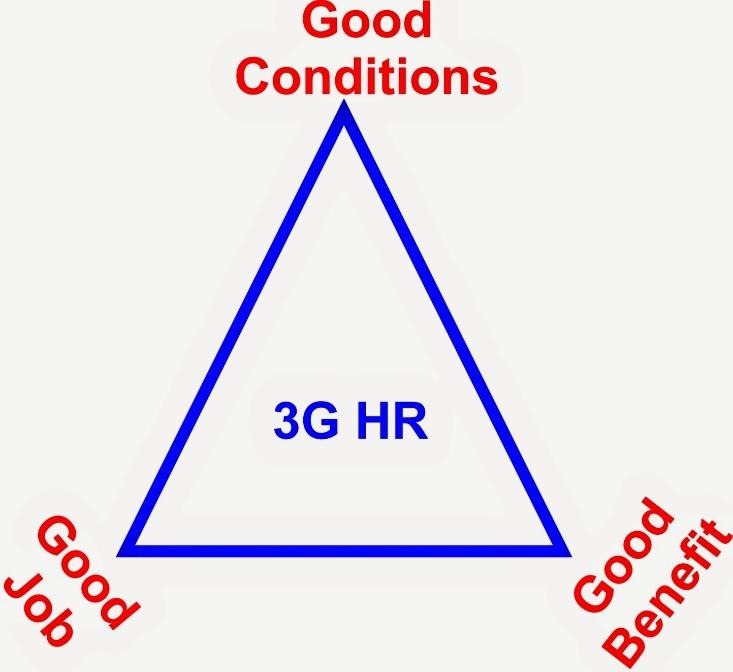
Figure 2
The 3G approach is aimed at more long-term cooperation and does not require the use of manipulative techniques, deception, withholding information, or other methods that make HR work emotionally uncomfortable.
Many world-famous successful corporations actually implement this very approach and build their HR policies based on the 3G principles described above.
In most companies in the post-Soviet space, the 3G approach is not used, since it is believed that the use of manipulative technologies is less costly and delivers the required result in a shorter time. This point of view is mistaken, and the undisputed leadership of companies applying approaches similar to 3G proves this.
The 3G approach allows you to assess HR’s contribution to the overall result, that is, to calculate it through a KPI system for HR.
KPI-1 Increase in the share (%) of employees in profit-generating departments out of the total number of company employees
KPI-2 Change in company profit per employee over a period,
KPI-3 Change in employee turnover over a period,
KPI-4 Change in MT&R (mutual trust and respect) over a period
All of these indicators can serve as criteria for evaluating the effectiveness and quality of the HR function.
To implement the 3G ideology in team practices and in the corporate culture, it is necessary to radically change the principles of HR policy. To do this, owners, top managers, and key specialists must be trained. There are two main approaches to implementing the 3G ideology:
1. Training managers and specialists of the company at LAM Business School
2. Holding a corporate strategic session (2–3 days), during which the foundations of the company’s HR policy will be reviewed
During the implementation of the 3G ideology, managers and specialists will be able to rethink the company’s goals, their own goals, find the correlation between them, discuss necessary changes in working conditions, in the personnel motivation model, understand and feel the difference between manipulative tools and tools of influence, master methods of organizing teamwork, learn to work constructively with conflicts within the team, reach a new level of relationships, understanding each other’s role and contribution to the overall result, and, as a result, move to an entirely new level of company development opportunities.
The application of the 3G methodology allows businesses to make a leap in a short time, find solutions to long-term problems that have not been solved before, and discover new business development opportunities that were previously not considered. In addition, the 3G approach gives HR an excellent guide for staff selection. After all, the 3G approach allows you to find exactly those people who fit into the 3G ideology. This eliminates the entry of people into the company with avoidant motivation and a victim mentality, for whom the principles of 3G are inapplicable.
Filyanin S.N.
10.2014