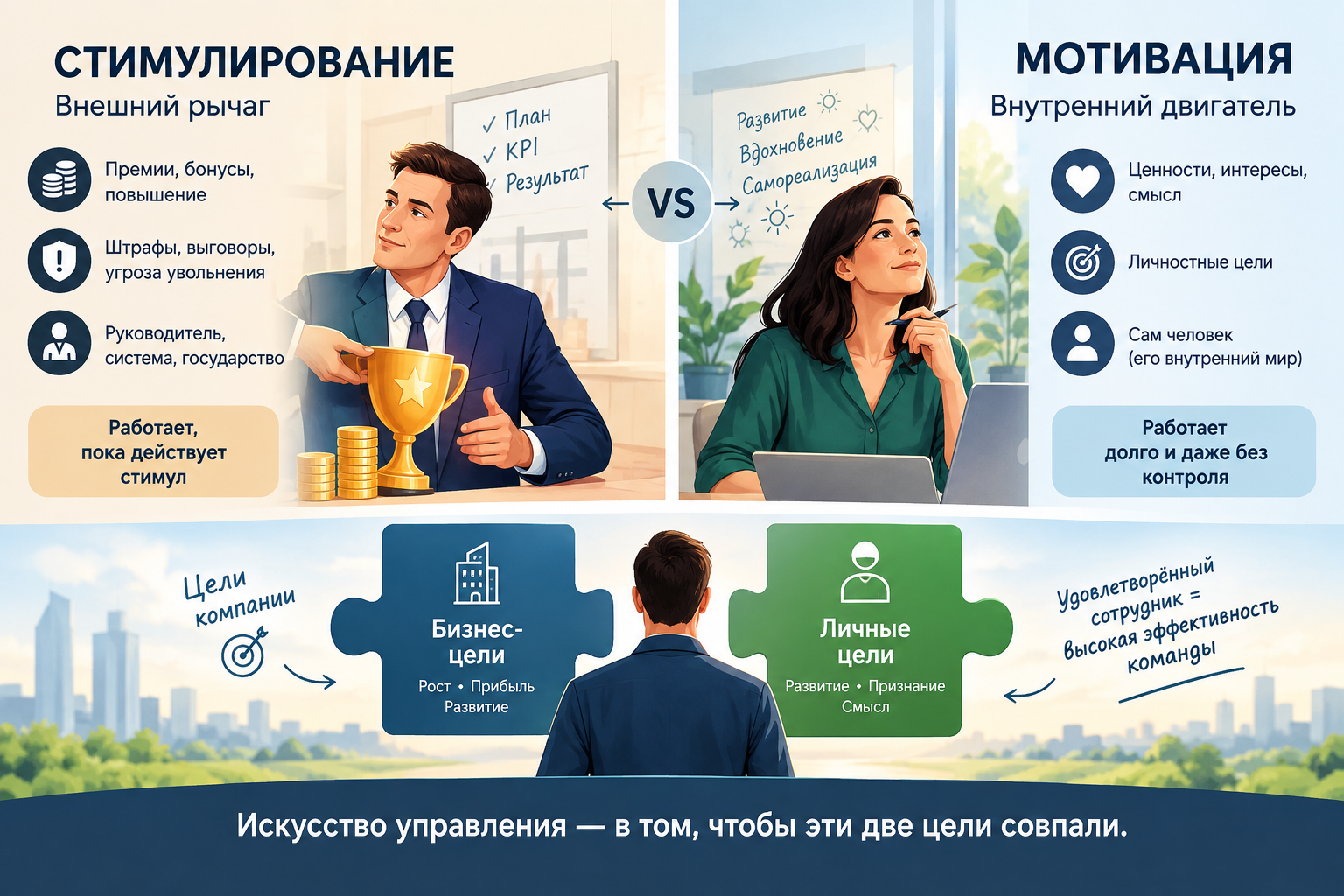
I think I would not be greatly mistaken if I assumed that far from all managers and business owners are satisfied with the results of the motivation models they use. Try to imagine a sales or service department without an operating motivation system. Such a thing does not exist! Parameters, calculations, clarifications, and as a result — significant amounts that you pay for the results achieved.
You fulfilled the sales plan — well done, here is your reward. Customers paid off their debts — even better, and if you fulfilled the margin plan — then you are a real hero.
But here is the question: do you really understand what motivation is and how it differs from incentivization?
Motivation and incentivization are two fundamental mechanisms for managing human behavior and activity, which are often confused, but they are aimed at encouraging action from opposite sides: “from within” and “from outside.”
Motivation (from Latin movere — “to move”) is a person’s internal drive toward activity, caused by their own needs, interests, values, beliefs, and goals.
- Essence: A person’s internal “engine.” A person does something because they themselves want to do it or see personal meaning in it.
- Source: Internal (the subjective world of the individual).
- Example: An employee learns a foreign language because they want to read professional literature in the original and broaden their horizons; or a designer creates a project at night because they are inspired and driven by excitement.
Incentivization (from Latin stimulus — “a pointed stick (thorn) used to drive cattle”) is an external influence on a person from the outside (a manager, a system, the state) with the aim of encouraging them to behave in a certain way or perform specific tasks.
- Essence: An external “lever” or “guide.” A person does something because it will be followed by a reward or the avoidance of punishment.
- Source: External (organizational environment, management).
- Types of incentives:
- Positive (bonus, reward, praise, promotion).
- Negative (fine, reprimand, threat of dismissal).
- Example: An employee exceeds the sales plan in order to receive a quarterly bonus (positive incentive) or avoids being late in order not to pay a fine (negative incentive).
Comparative analysis:
| Criterion | Motivation | Incentivization |
|---|---|---|
| Direction of influence | From inside out (internal drives shape behavior). | From outside in (an external incentive engages internal needs). |
| Source | The person themselves (their values, meanings, needs). | External system / Manager / Environment. |
| Nature of influence | Psychological, meaningful, value-based. | Administrative, material, organizational. |
| Duration of effect | Long-term. Works even in the absence of external control. | Short-term / Medium-term. Works as long as the incentive remains in place. |
| Resource costs | Requires time for development, selection, and alignment of values. | Requires direct financial, material, or administrative resources. |
| Type of behavior | Proactive, creative, conscious. | Performative, reactive, formal. |
Key differences:
- Subject of management: Motivation belongs to the person themselves (you cannot “motivate” another person directly — you can only create conditions in which their internal motivation can unfold). Incentivization is a tool belonging to an external subject (the manager).
- Sustainability: A motivated person continues to work with high commitment even during temporary difficulties, a crisis, or in the absence of immediate payment. An incentivized employee sharply reduces their activity as soon as the bonus is canceled or control disappears.
- Dependence and habituation: Incentives have a “threshold of sensitivity” effect (people get used to bonuses, and they stop driving them; fines begin to cause sabotage). Motivation based on self-realization and meaning may only become stronger over time.
Incentivization is an external “adjustment” that works effectively only when it is based on a person’s internal motivation.
If you offer a person a monetary bonus (incentive) for work that contradicts their values or causes deep rejection (motivation), the incentive will either not work at all or will lead to rapid burnout.
Ideal management consists in using quality incentivization (fair pay, recognition, conditions) to create an environment in which people’s internal motivation flourishes.
So what are you actually doing? It turns out that, for the most part, you are building a system of material incentives without delving into the employee’s personal internal motivation, and that is why you get a result different from the expected one.
And what happens if an employee is motivated? What is the difference for the employer, what is the benefit?
Imagine that, in addition to achieving the planned performance indicators that provide a bonus, your employee clearly understands how this helps them personally achieve their goals. They received a bonus — went on vacation with their family, bought their son a laptop, or finally finished renovating their apartment. They will do much more than what is written in the instructions. Their internal motivation can move mountains when they clearly understand which personal goal they will achieve by achieving yours.
Be honest: do you make an effort to find out why your employee goes to work? What are their personal, internal goals? Will they be able to achieve them by working at your company? And if not, then what? Burnout, disappointment, reduced efficiency and usefulness?
After all, it is not difficult at all to ask during regular one-on-one or group meetings. How much closer is the employee getting to their goals by achieving the company’s goals? Isn’t that the manager’s task? Of course, in companies with an authoritarian management style, frank conversations are more of an exception. But if you have a democratic management style, the algorithm is not complicated:
- determine your subordinate’s motivational profile (for example, according to Gerchikov);
- find out what personal goals the employee sets for themselves (if they are willing to share this);
- clarify the “bridge” of how, by achieving the company’s goals, they can achieve their own goals;
- take the motivational profile into account when developing the incentive system;
- make sure that your employee clearly understands how achieving the company’s goals and the established KPIs helps them achieve their personal goals.
It seems that there is nothing complicated about it, but this is the path toward individual incentive models and creating conditions for personal motivation to manifest itself. This is one of the tools of the LAM — Loss Avoidance Methodology — methodology developed by my colleagues and me. The task of an incentive system is not to “force” a person to work, but to highlight a direct connection for them: “By achieving the company’s KPIs, I am guaranteed to move toward my personal life goals.”
The clearer the connection between an employee’s result and their personal goal, the less the manager has to “buy” the desired behavior with additional incentives.
Incentivization encourages a person to do what the company needs. Motivation — to do what they themselves want. The art of management lies in making these two goals coincide.
The effect will surprise you; it is similar to the effect of resonance. Now the main thing is not to fall behind with goals and to provide the necessary resources: authority, information, time, tools, people…
Try it — everything is in your hands!
S.N. Filyanin 09.2026