
I. Adizes’ approach is now widely known and used by major consulting firms, executives of the largest enterprises and holdings, as well as owners of small and medium-sized businesses. Institutes of I. Adizes established in various countries are actively working to promote the approach, providing support to owners and top managers.
The very idea of the business lifecycle is intuitively perceived as convincing, even indisputable. The classifications developed within this approach appear to be quite practical and useful as tools.
However, although adherents of the approach use it skillfully and expertly, it is clear that this approach is not suitable for every manager, and in some cases, the Adizes approach is not the solution to the problem.
There is a saying that a true test pilot can fly anything, even a stool. A true manager can use almost any methodology (provided, of course, that it is a coherent methodology and not a mishmash of absurd statements and intuitive insights), and the business project will ‘take off.’ At the same time, an unskilled manager can use any methodology, and it will have no positive effect.
Therefore, it is naive to take a manager’s familiarity with any methodology as a sign of their managerial competence. Competence and knowledge are not so directly correlated.
The purpose of this publication is to present the sharpest critical attacks on I. Adizes’ approach and to see how the Adizes approach itself absorbs and mitigates these blows.
Critical Argument #1
The I. Adizes approach assumes that every company progresses through life cycle stages, changing the main characteristics of its management system along the way. This thesis seems indisputable—until we start applying its idea to real companies. If a company changes every year or every two years by launching new business lines, then each business line is a new start, the beginning of a new life cycle. Some of these new directions may become the company’s core businesses in 3–5 years. So, according to Adizes, how should the management system be structured in a company where, for example, five new businesses were launched 5, 4, 3, 2, and 1 years ago, respectively?
A life cycle stage is no more than an illustration or metaphor that makes the Adizes approach easy to understand and grasp. In essence, the famous curve reflects the cumulative effect of three pairs of contrasting parameters in the management system: ‘flexibility — rigidity’, ‘efficiency — inefficiency’, ‘simplicity — complexity’. Efficiency is closely associated with transparency (accountability), since an efficient business is always informationally transparent, generating reliable reports that form the basis for effective decision-making.
If a company is flexible, efficient, and simple—this is the ‘infancy’ stage, and it is clear that complex approaches or bureaucratic systems are not suitable for it. When a company reaches the level of business that requires specialization and distribution of responsibilities (for example, due to a large number of business areas), its efficiency may decrease if the management system is not made more complex in a timely manner. Increasing complexity and a certain reduction in flexibility can deliver even higher efficiency. This is the ‘High Activity’ stage or ‘Go-Go’ period, which ends when another round of increasing complexity and rigidity in the management system becomes necessary. At this point, the management system becomes so complex that bureaucracy appears in the company and decentralization of authority begins (delegating powers to top managers). In other words, the flexibility of the system is now ensured by distributing management functions across business areas.
The flourishing stage, which follows this adolescence, is characterized by an even greater complication of the management system and the discovery of a balance between rigidity and flexibility. This balance emerges when a systematic approach to company management is implemented.
We will leave it to the reader to independently explore how the values of opposing management system parameters change at subsequent stages of the life cycle. But I think the idea behind the approach is clear.
At any stage, due to managerial errors (by those who ‘can’t fly anything’), a company can lose its effectiveness and die, as depicted on the life cycle curve in the form of side branches leading to its demise.
The analysis we have provided helps us understand that it’s not about the life cycle itself, and that a company’s lifespan is not predetermined in the same way as that of an individual organism, which is born, goes through childhood, youth, adulthood, ages, and dies. Companies do not have to grow old. The life cycle is merely an illustration of the combination of three pairs of opposing management system parameters, which are selected as optimal for each company and each business situation. We can even go further: from time to time, a company can move back along the life cycle curve, ensuring the necessary level of efficiency, flexibility-rigidity, and complexity of the management system.
Therefore, if a company regularly creates new businesses, this does not mean it is returning to the beginning of its journey: the complexity of its management system increases proportionally to ensure the required efficiency and the necessary balance of rigidity and flexibility. This is the main idea of the approach. By determining which management system will be most appropriate and effective in this case, we can begin to build it, moving from abstract target parameters of the management system to specific things: mission, values, functions, business processes, distribution of powers and responsibilities, building a BSC, creating the necessary managerial reporting, linking KPIs to employee bonuses, and so on.
Critical Note #2
The I. Adizes approach extensively uses the PAEI management vitamins, which are usually interpreted as follows:
P — production of results (functioning)
A — administration, order, discipline
E — entrepreneurship, creativity, risk, development
I — integration, creating an atmosphere of cooperation and interaction, self-organization, and corporate culture
The selection of these particular roles (characteristics, qualities, management vitamins) seems somewhat strange, since each is identified based on different classification criteria; in other words, they do not represent a holistic entity with distinct parts. As a result, the question arises about the completeness of these characteristics.
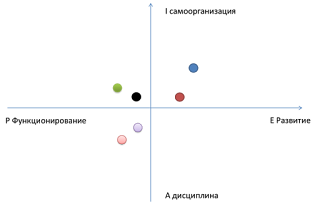
In a certain sense, ‘management vitamins’ are a way of popularizing I. Adizes’s approach. They are simple and intuitive. It is quite possible to select a common basis for classification, although it is not explicitly described anywhere in I. Adizes’s books. Essentially, the highlighted characteristics represent two opposing pairs of parameters describing management styles. They can be reformulated as: ‘functioning’ – ‘development’, ‘discipline’ – ‘self-organization.’ If you construct Cartesian coordinates with these characteristics and measure the corresponding manifestations of management style among your company’s top managers (in the diagram you see six points, corresponding to the coordinates of six top managers), you will get an idea of where the ‘center’ of mass is for your cloud of points visualizing management styles. To build such a diagram relevant to your company, you should ask your top managers to take the PAEI indicators test, then find the difference between E and P (subtract the P score from the E score); this way, you get the coordinate along the horizontal axis. Then, find the difference between I and A (subtract the A score from the I score), thus obtaining the coordinate along the vertical axis.
If your company tends to favor discipline and operation, then you are ‘aging’ along the life cycle curve; if you prefer self-organization and development — then you are evolving. It should be emphasized that nothing prevents you from reorienting in time and completely changing management styles in your company, thus moving along the life cycle curve to a different area.
Critical Remark #3
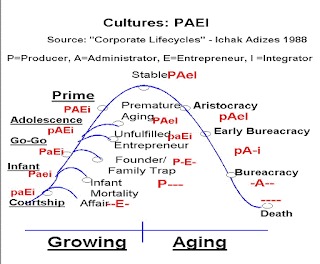
‘Management Vitamins’ PAEI are often linked to the stage of the life cycle. It is assumed that there are certain preferences that determine the management style and the stage at which the company is. However, different departments within a company have different PAEI indicators. It cannot be otherwise. It’s hard to imagine a security or accounting department whose management style can be described as paEi.
Obviously, the very concept of ‘the management style that is most preferable for a given stage of the life cycle’ does not withstand even the most basic criticism. Throughout the company, and especially in a company where new business directions regularly arise, management styles will vary, and talking about any kind of ‘single’, ‘most preferable’, or ‘suitable’ style, inventing various ways to derive an integrated indicator, is as naive as judging patients’ health based on the average temperature in the hospital.
The relationship between the prominence of certain components in the management style and the stage of the life cycle in I. Adizes’ approach is largely illustrative, showing that the older the company, the more bureaucracy and rigidity it has, and the less entrepreneurship and self-organization.
The PAEI classification is nothing more than a language with which one can discuss such qualitative characteristics of a company as a whole. I. Adizes never claims that all key managers of a company at a given stage of the life cycle must possess the corresponding PAEI characteristic profile.
In I. Adizes’ approach, it is difficult to see any kind of rigidity or determinism, inevitability of certain processes. On the contrary, the whole essence of the approach is to move away from predetermination, to consciously choose the most effective management system, and even to a large extent to manage age-related changes, sometimes reversing or stopping social time.
Using the Cartesian coordinates described above, and plotting the PAEI of your managers on them, you can easily calculate the geometric center of the points (as the arithmetic mean of all horizontal and vertical coordinates), and see in which quadrant it is located. Then you can calculate the variance (the spread of points from the geometric center), and thus obtain a numerical expression of the degree of certainty of a unified management style in the company.
By calculating the scalar products of vectors drawn from each point to the geometric center for every pair of points, you will obtain the coefficient k, whose negative values indicate a ‘potential management conflict’, while positive values indicate a ‘potential management alliance’. The absolute value of this coefficient can be interpreted as the degree of intensity of the management conflict or alliance. Thus, using the PAEI language and Cartesian coordinates, you can create a management model of your company and see the spectrum of management strategies your team can potentially implement.
PAEI is nothing more than a model. And although a model is a well-known way of studying reality, one should not confuse the map with the territory, or the model with reality. Remember, a model cannot be true or false; it is a tool, and such notions do not apply to tools. Can a hammer, for example, be true or false? Or a screwdriver?
However, a model can be applicable or inapplicable, useful or useless, convenient or inconvenient. What we want to say is that the approach of I. Adizes is, essentially, instrumental. And you can choose to use it or not. After all, if you are reading these lines, you are a manager, and a manager differs from the managed in that they themselves create the conditions and circumstances in which activities are carried out, including choosing which models are applicable or not in a given situation.
Conclusion:
Companies can live for centuries without aging. I. Adizes’ approach is not a dogmatic system that ‘forces’ all companies to follow a strictly defined curve of the life cycle. It is merely one of the instrumental approaches that skilled managers can use in their daily work.
Sergey Filyanin
08.2016