Although wise Chinese people do not advise living during times of change, in the modern world we are forced not only to live through change, but also to actively adapt to it, and sometimes even initiate it. So how can we understand what changes are happening now and how to react to them? Should we ignore them, resist them, or actively support them? I have tried to make sense of the changes initiated by the state in relation to its citizens. After all, you’ll agree, much now depends on the direction chosen and the changes taking place. How does the state show its activity? It communicates with us through laws, decrees, programs, slogans, and so on. That is, using available communication channels—through audio, video, texts, and other types of content—it informs us about its plans and the current achievements of state authorities. It takes action: making decisions, allocating resources, implementing projects, overseeing the execution of its decisions, imposing restrictions on the one hand and lifting them on the other—in general, it carries out state activities. In other words, the state communicates with us and performs activities. You don’t have to be particularly advanced to accept that communication and activity aimed at creation are always good and right, while communication and activity aimed at destruction are in most cases bad and wrong.
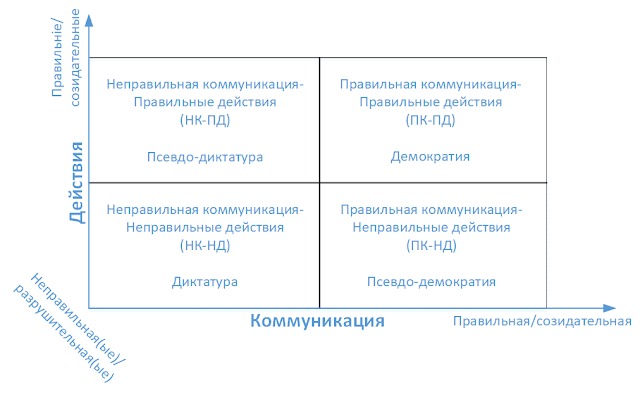
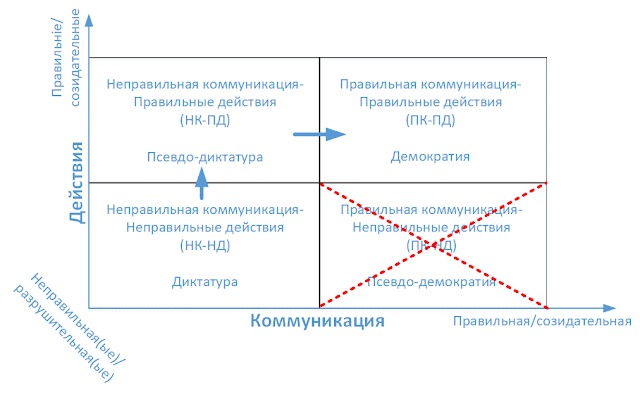
As shown in the diagram above, there are 4 possible combinations. The first is when both communication and the actions of the state are wrong, aimed at destroying NC-ND. I called this combination a Dictatorship. The state keeps the population in fear, acts repressively, destroying any beginnings of freedom and democracy. A vivid example is the Stalinist period of the USSR, modern-day North Korea, some African and Latin American countries. Such a combination is necessary to create the most favorable conditions for the existence of a dictatorial regime. Dictatorship, in the context of this article, is the opposite of Democracy.
The second is when communication is wrong, but the actions are correct NC-PA. This combination describes a situation in which the state continues to use the old rhetoric, but implements actions that are different from what is being communicated. For example, a program is implemented to reform an important sector of the economy, which will clearly lead to the creation of new jobs, increased labor productivity, and improved welfare of the population, but this implementation is accompanied by communication based on destruction and denial. Striking examples include Poland after the collapse of the USSR. All communication was based on destroying the old order, denying former achievements, rethinking history, while actions were aimed at building new things: creating new institutions of power, developing new sectors of the economy, integrating into the global market, etc. I called this stage a Pseudo-dictatorship.
Third, when correct communication is in place, but incorrect actions are implemented—CC-IA. In this combination, the state deceives the hopes of its people. Communication is directed toward the development of democracy, freedom of choice, free competition, but the actions do not correspond to the communication. And under the guise of the right slogans, there is corruption, disregard for laws, nepotism, criminal monopolization of economic sectors, imitation of reforms, and so on. In other words, the activities are far from constructive and far from correct. A vivid example is modern Ukraine. Despite communication in a democratic style and alignment with the expectations of the population, the actions are aimed in the opposite direction. I have called this combination Pseudo-democracy.
Fourth, when both communication and actions are correct and aimed at creation—CC-CA. In this combination, the state seeks, both in its communication and in its actions, to meet the expectations of its people. It develops and protects democratic freedoms, does not conceal or downplay important information, and strives to raise social standards. I have called this combination Democracy. Real democracy, which so far is the highest achievement in the governmental management model. All states should strive for this combination.
Now, a bit about strategy, or the path to achieving a complex goal. The paths can be different; it depends entirely on us which one our state will take. We have broken out of Dictatorship, moved into Pseudo-Democracy, and now we can either move toward Democracy or remain for a while longer in Pseudo-Dictatorship. Poland, for example, moved from Dictatorship to Pseudo-Dictatorship and is now in Democracy.
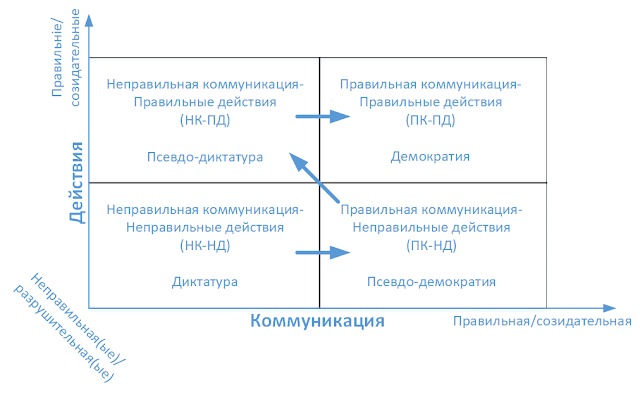
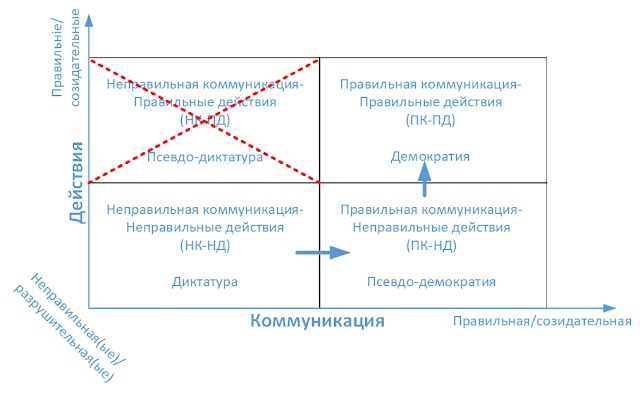
Do we still have time for extra stages? Will the population have enough trust and patience left? The correctness of the strategy chosen by the new president will determine how quickly trust in the state, its communication, and its activities can be restored.
Filyanin S.N.
06.2019